
Why Safety Nets Are Essential for Modern Residential Buildings
Modern homes are designed to be spacious, comfortable, and visually appealing. Balconies, large windows, open staircases, terraces, utility areas, and high-rise apartment spaces have become common features of residential buildings.
While these features make a home more enjoyable, they can also create safety concerns—especially for families with young children, pets, and elderly members.
This is where safety nets for residential buildings can provide a practical additional layer of protection.
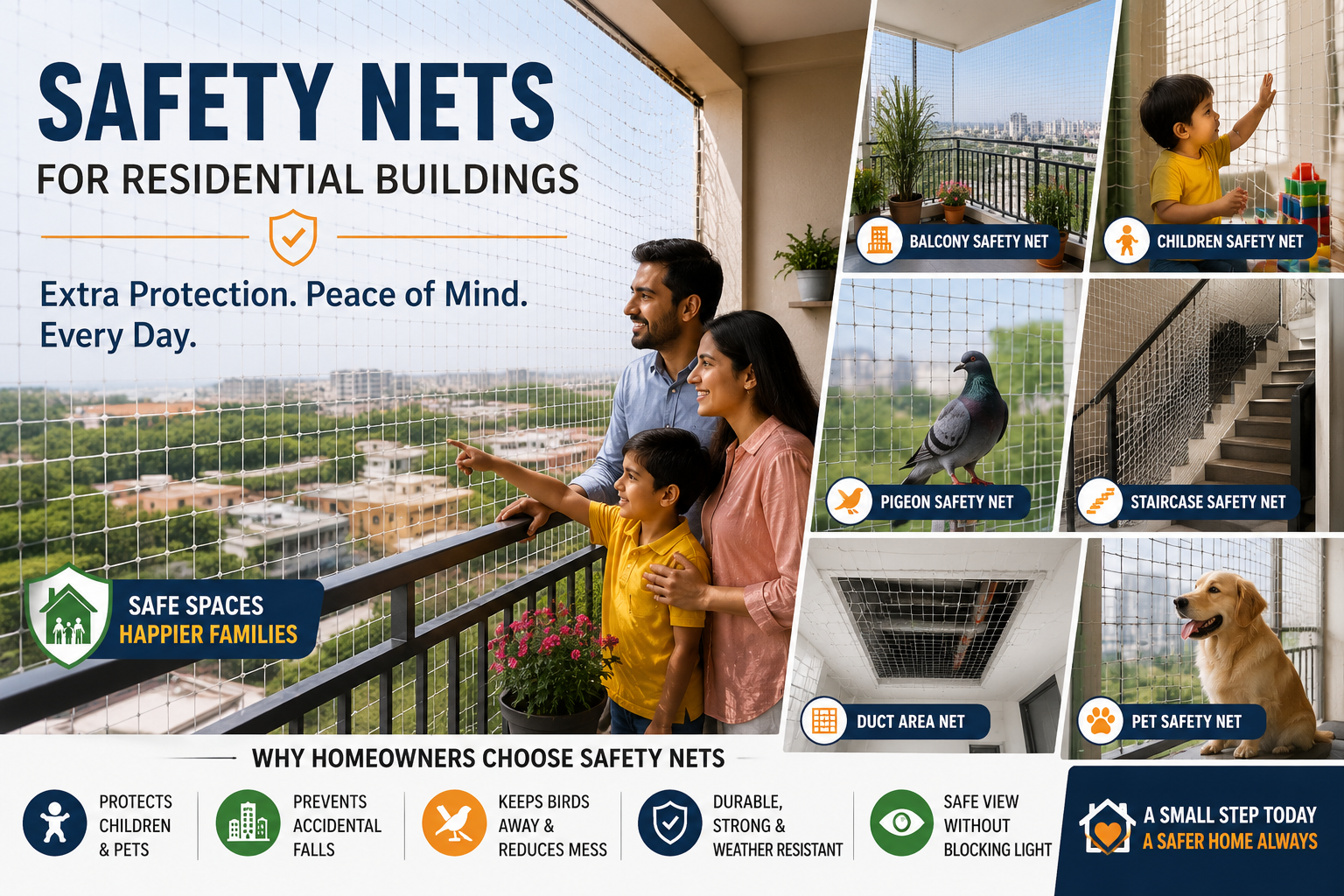
From balcony safety nets and children safety nets to pigeon nets, staircase nets, and duct area nets, there are different types of safety solutions designed for different areas of a home.
Let’s understand why safety nets have become an important consideration for modern residential buildings.
What Are Residential Safety Nets?
Residential safety nets are specially designed netting systems installed around potentially risky or open areas of a property.
Depending on the application, they can help:
- Reduce the risk of accidental falls
- Keep children away from dangerous openings
- Protect pets from balconies and staircases
- Prevent birds from entering balconies
- Reduce the chance of lightweight objects falling
- Protect open utility and duct areas
- Improve safety around certain residential spaces
The right net depends on the location, purpose, structure, and intended use.
1. Provides Additional Protection for Children
Children are naturally curious. They may climb furniture, explore staircases, lean toward balcony railings, or try to reach objects outside an open area.
In apartments and multi-storey homes, these situations require extra attention.
A properly selected and professionally installed children safety net can provide an additional physical barrier around areas where accidental falls could occur.
However, safety nets should never be treated as a replacement for adult supervision.
Parents should also:
- Keep climbable furniture away from balconies.
- Supervise young children.
- Prevent children from climbing on safety nets.
- Keep dangerous objects away from open areas.
- Regularly inspect the net and fixing points.
2. Makes Balconies Safer
Balconies are among the most common areas where homeowners consider installing safety nets.
An open balcony can present risks for children and pets, particularly in high-rise apartments.
A balcony safety net can create an additional barrier while allowing homeowners to continue enjoying:
- Fresh air
- Natural light
- Outdoor views
- Balcony plants
- Open surroundings
For apartment residents, this can be a simple way to improve the overall safety of their living space.
3. Helps Protect Pets
Pets don’t always understand the dangers associated with balconies and open areas.
A cat may chase a pigeon, a puppy may try to squeeze through a railing, or a small dog may jump unexpectedly.
Pet owners can use suitable balcony or pet safety nets to create an additional protective boundary.
These solutions can be especially useful for:
- Cats
- Kittens
- Puppies
- Small dogs
- Other small domestic pets
The mesh size and installation method should be selected according to the animal and the specific application.
4. Helps Prevent Pigeon and Bird Problems
Birds can quickly turn an otherwise clean balcony into a difficult space to maintain.
Pigeons may perch on railings, build nests, and leave droppings across floors, walls, furniture, and air-conditioning units.
A properly installed pigeon safety net can help prevent birds from entering the protected balcony area.
This can help reduce:
- Bird droppings
- Nesting
- Feathers
- Unpleasant smells
- Frequent cleaning
For bird control, the net should be selected specifically for the intended bird-exclusion application.
5. Helps Improve Staircase Safety
Open staircases can be another area of concern in modern homes.
Children and pets may move quickly around staircases, and objects can sometimes fall through open spaces.
A staircase safety net can provide an additional barrier around suitable staircase openings.
It can be particularly useful in:
- Duplex homes
- Villas
- Apartments
- Buildings with open staircases
- Homes with young children or pets
The structure should be professionally assessed before installation to determine the appropriate fixing method.
6. Protects Open Duct Areas
Residential buildings often have service ducts and other open utility spaces.
These areas may be difficult to access and can create safety concerns if they are left open.
Duct area safety nets can be customized to cover suitable openings and help prevent accidental access or falls.
They can also provide an additional barrier against objects falling into difficult-to-access spaces.
7. Adds Protection Without Blocking the View
One reason safety nets are popular in modern homes is their relatively unobtrusive appearance.
Compared with heavy barriers, fine-mesh safety nets can maintain:
- Natural light
- Airflow
- Ventilation
- Visibility
When professionally installed, they can blend with the existing balcony or building structure.
This is particularly important for homeowners who want to improve safety without making their property look heavily enclosed.
8. Suitable for High-Rise Residential Buildings
High-rise living has become increasingly common in cities such as Hyderabad.
Apartments may have multiple balconies, open utility areas, large windows, and shared spaces that require different safety considerations.
Safety nets can be customized for many residential applications, including:
- Apartment balconies
- Utility balconies
- Children’s play areas
- Staircases
- Duct areas
- Open terraces
- Bird-prone areas
A professional site inspection can help determine which type of net is appropriate for each location.
9. UV and Weather Resistance Matters
Residential safety nets installed outdoors are exposed to sunlight, rain, dust, and changing weather conditions.
For outdoor applications, homeowners should look for materials designed for exterior use and suitable UV resistance.
This is particularly important in sunny climates.
When choosing safety nets, ask the installation company about:
- UV resistance
- Weather resistance
- Material quality
- Tensile strength
- Expected outdoor performance
- Fixing system
The actual lifespan will depend on the material, exposure, installation quality, and maintenance.
10. Provides a Practical Alternative to Heavy Barriers
Traditional metal grills and other permanent barriers can sometimes alter the appearance of a home.
Safety nets offer a lightweight alternative for applications where netting is appropriate.
They can often be customized according to:
- Balcony size
- Railing design
- Wall structure
- Ceiling height
- Required coverage
- Intended purpose
However, the appropriate solution depends on the specific safety requirement and building structure.
Different Types of Safety Nets for Residential Buildings
Modern homes can require different safety solutions.
Balcony Safety Nets
Designed to provide an additional barrier around open balconies.
Pigeon Safety Nets
Used to help prevent pigeons and other birds from entering balconies and protected areas.
Children Safety Nets
Designed for suitable residential areas where additional child protection is required.
Staircase Safety Nets
Used around suitable open staircase areas to provide an additional protective barrier.
Duct Area Safety Nets
Designed to cover appropriate open ducts and service areas.
Bird Protection Nets
Used to keep unwanted birds away from balconies and other residential spaces.
Swimming Pool Safety Nets
Designed for appropriate pool areas as an additional protective measure.
Why Professional Installation Is Important
The effectiveness of a safety net depends not only on the net itself but also on how it is installed.
Professional installation generally involves:
Site Inspection
The technician examines the structure and identifies suitable fixing points.
Accurate Measurement
The area is measured to ensure proper coverage.
Material Selection
The appropriate mesh and material are selected based on the intended purpose.
Secure Fixing
The net is attached to suitable structural points using appropriate fixing accessories.
Final Inspection
The completed installation is checked for gaps, loose sections, and overall coverage.
A poorly fitted net can reduce the effectiveness of the solution, so professional installation is particularly important for high-rise and difficult-to-access areas.
How to Choose the Right Safety Net for Your Home
Before installing a safety net, consider the following factors.
Identify the Purpose
Are you looking for child protection, pet protection, bird control, or fall prevention?
Check the Material
Choose a product designed for the intended indoor or outdoor application.
Consider UV Resistance
Outdoor nets should be suitable for prolonged sunlight exposure.
Check the Mesh Size
The mesh should match the intended use.
Look at the Fixing System
Strong and appropriate fixing points are essential.
Choose Experienced Installers
An experienced team can assess the structure and provide a more suitable installation.
Ask About Maintenance
Understand how the net should be cleaned and inspected and what to do if it becomes damaged.
Safety Nets Are Not a Substitute for Supervision
Although safety nets can provide an additional protective barrier, homeowners should not rely on them as the only safety measure.
For families with children:
- Keep children supervised around balconies.
- Don’t allow climbing on nets.
- Keep furniture away from railings.
- Inspect the installation regularly.
For pet owners:
- Monitor pets around balconies.
- Choose an appropriate mesh size.
- Check whether your pet scratches or bites the net.
- Repair damage immediately.
Good safety practices combined with appropriate safety products provide better protection.
Why Choose Lakshmi Safety Nets Hyderabad?
Lakshmi Safety Nets provides customized safety net solutions for residential, commercial, and industrial properties in Hyderabad.
Our services include:
- Balcony Safety Nets
- Pigeon Safety Nets
- Children Safety Nets
- Bird Protection Nets
- Bird Spikes
- Staircase Safety Nets
- Duct Area Safety Nets
- Building Safety Nets
- Construction Safety Nets
- Industrial Safety Nets
- Swimming Pool Safety Nets
- Car Parking Safety Nets
- Monkey Safety Nets
- Coconut Tree Safety Nets
We focus on durable materials, customized measurements, professional installation, and practical safety solutions for different property requirements.
Frequently Asked Questions
Are safety nets suitable for residential buildings?
Yes. Different types of safety nets can be used for appropriate residential applications such as balconies, staircases, ducts, and bird protection.
Are safety nets safe for children?
A properly selected and installed net can provide an additional barrier in suitable areas. However, children should always be supervised and should not be allowed to climb or lean against the net.
Can safety nets protect pets?
Yes. Balcony and other suitable safety nets can help reduce the risk of pets escaping or accessing dangerous open areas.
Do safety nets block sunlight and airflow?
Fine-mesh nets generally allow air and natural light to pass through, although the exact visibility and airflow depend on the mesh design.
How long do residential safety nets last?
There is no single lifespan for every net. Durability depends on material quality, UV exposure, weather, installation, and maintenance.
Can safety nets be customized?
Yes. Safety nets can often be customized according to the dimensions and structure of the area being protected.
Final Thoughts
Modern residential buildings are designed around open, functional spaces, but these spaces also need thoughtful safety planning. Safety nets for residential buildings can provide an additional layer of protection for balconies, children, pets, staircases, duct areas, and bird-prone spaces.
The biggest advantage is their combination of practical protection, ventilation, natural light, and relatively low visual impact.
Whether you live in a high-rise apartment, villa, or independent home in Hyderabad, start by identifying the areas that need additional protection. Then choose the right type of net, use quality outdoor-grade materials where required, and have it professionally installed.
A safer home doesn’t necessarily need to look different—it simply needs the right safety solutions in the right places.